Turnitin Similarity Score: What Percentage Is Too High?
There's no universal cutoff — but there is a real framework behind the number. Here's how Turnitin's color bands work, why scores run high even with proper citation, and what actually counts as a problem.
The quick answer
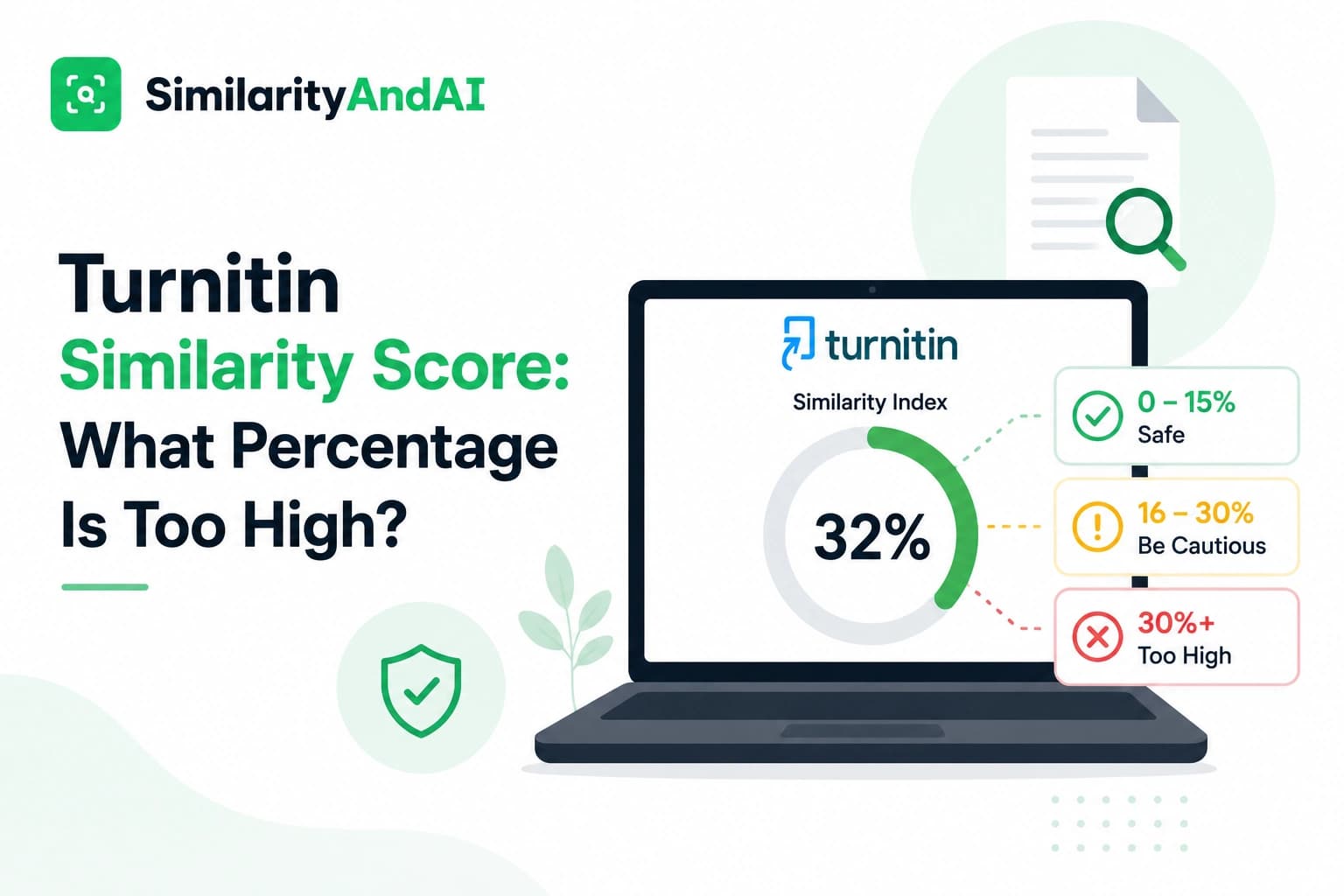
There is no universal percentage that counts as "too high." Turnitin itself doesn't publish or enforce a pass/fail cutoff — per its own guidance on understanding the similarity score, the number represents the percentage of a submission's text that matches existing content in its databases, not a plagiarism verdict. Some institutions informally treat anything above roughly 20–25% as worth a closer look; others set no threshold at all and leave every score to instructor judgment. The honest answer is that the percentage alone tells you less than what's actually inside it.
Why there's no universal number
This trips up a lot of students looking for a clean rule, but the reason is structural: similarity is a measure of textual overlap, and how much overlap is normal varies enormously by assignment type. A literature review that quotes and synthesizes a dozen sources will legitimately run higher than a personal reflection essay. A lab report using standardized methodology language will score differently than a persuasive essay written from scratch. Turnitin's own materials are explicit that interpreting the number requires looking at the assignment's context, not applying a fixed rule across every submission.
That's why the setting of any threshold is left entirely to institutions and individual instructors. Some departments apply a blanket number as an initial screening flag; many don't use one at all, and rely on the instructor reading the actual report.
Turnitin's color bands, explained
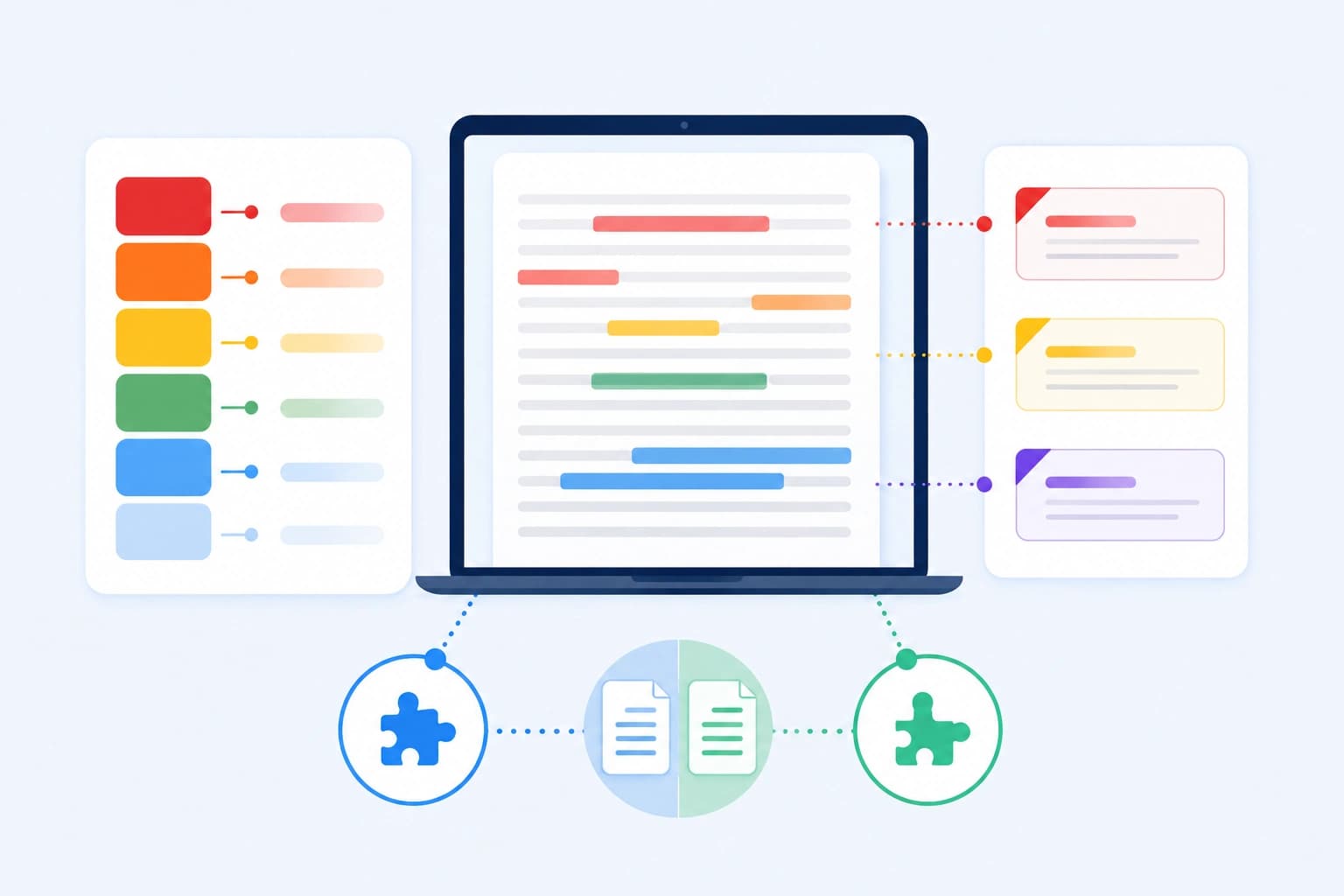
Turnitin displays the similarity score with a color indicator, which is often mistaken for a grading scale. It isn't — it's just a visual range marker:
Blue — 0%
No matching text found.
Green — 1–24%
A low level of matching text.
Yellow — 25–49%
A moderate level of matching text.
Orange — 50–74%
A moderate-to-large level of matching text.
Red — 75–100%
A large amount of matching text.
These bands describe the amount of overlap, not its severity or legitimacy. A yellow-band paper built almost entirely from properly quoted and cited material can be completely fine; a green-band paper with a handful of unattributed copied sentences buried in it can be a real problem. The color tells you how much text matched something — it says nothing about why.
What actually drives a score up
Several things inflate a similarity score that have nothing to do with academic dishonesty:
- Quoted material. By default, a properly quoted and cited passage still counts as a text match, because the words match a source — Turnitin flags the overlap regardless of attribution. Reports can be configured with exclusion filters for quotes, but if those filters aren't applied, correctly quoted text inflates the score.
- Bibliography and reference lists. Full citations are, by definition, text that matches other publications listing the same source. Like quotes, these can be excluded via filters, but count by default.
- Common phrases and standard terminology. Field-specific language, methodology descriptions, and widely used phrasing show up as matches simply because many people write the same standard phrases the same way.
- Filter and formatting issues. Turnitin's own help center notes technical quirks that inflate scores unexpectedly — mismatched quotation marks can prevent the system from correctly excluding quoted text, and a bibliography exclusion keyword only works from its last occurrence in the document, so a table of contents mention can accidentally include everything after it in the excluded zone rather than the intended reference list.
Why a high score isn't automatically plagiarism
Given all of the above, a high number is frequently just heavy, correct citation — not misconduct. A dissertation chapter built on twenty properly quoted sources, or a case study paper following a required standard structure, can land in the yellow or even orange band while being completely original scholarship with nothing improperly borrowed. The percentage is the starting point for a human reading the report, not the conclusion.
Why a low score isn't automatically safe
The reverse matters just as much, and gets less attention. A low score can still contain a real problem — a handful of unattributed sentences dropped into an otherwise original paper can be a small percentage of the total document while still constituting the exact kind of unattributed copying an instructor is looking for. As covered in our comparison of Turnitin and free plagiarism checkers, a low score also only reflects what Turnitin's databases could actually match against — it isn't proof that every sentence in the document is demonstrably original, just that nothing matched what was searched.
What instructors actually look at instead of the number
In practice, instructors who use Turnitin regularly tend to care less about the headline percentage and more about the composition of the matches: is the flagged text quoted and cited correctly? Does it cluster in a few sentences or spread evenly across the whole paper? Is it matching a single source repeatedly, suggesting reliance on one text without proper attribution? Is the phrasing suspiciously close to a source without quotation marks at all? Those questions are answered by opening the report and reading the highlighted matches, not by looking at the top-line number.
Rough benchmarks, with heavy caveats
With the caveat that none of this is an official standard, informal ranges commonly cited by instructors and writing centers tend to look roughly like this: scores under 15% are usually treated as unremarkable for most essay-style assignments; 15–25% often prompts a quick check of what's matching, without automatic concern; above 25–30% is where many instructors will actually open the report and read the matched sections rather than glance at the number. Research-heavy work — literature reviews, systematic reviews, dissertations with extensive quoted material — routinely and legitimately runs higher than these ranges. These are patterns observed across many institutions, not a rule that applies to your specific assignment.
The only benchmark that actually matters is your own institution's or instructor's stated expectation. Check your syllabus or assignment brief first; if nothing is specified, ask directly rather than assuming a number you found online applies to your course.
What to actually do before you submit
If you want to catch a genuine problem — rather than just chase a lower number — the useful exercise is reading your own similarity report the way an instructor would: open every significant match and check whether it's quoted and cited correctly, whether it's clustered suspiciously, and whether any of it is paraphrased closely enough to a source that it should have been quoted directly instead. That's a fundamentally different process than panicking over a percentage in isolation.
Doing that requires seeing an actual Turnitin report, not a free tool's estimate — a distinction covered in more depth in our piece on checking your Turnitin score before submitting, since most students don't have a straightforward way to generate one on demand.
The bottom line
There's no percentage that's inherently too high or safely low — Turnitin doesn't set one, and the honest answer to "what score is bad" is "it depends what's inside it." The color bands describe how much text matched something, not whether that match is a problem. The number is worth checking, but the report underneath it is what actually matters.
If you want to see your real similarity score — and read what's actually driving it — before you submit, you can check your reports through SimilarityAndAI, the same Turnitin engine your institution uses, delivered per report.
Frequently asked questions
Is a 20% similarity score bad?
Not necessarily. Twenty percent falls in Turnitin's green band (1–24%), which the system itself classifies as a low level of matching text. Whether it's a problem depends entirely on what that 20% is made of — properly quoted and cited material versus unattributed copied text read completely differently, even at the same percentage.
What similarity percentage is considered safe?
There's no number that's universally safe, because Turnitin's score measures textual overlap, not plagiarism. A heavily quoted, properly cited literature review can score 35% and be entirely legitimate, while a 12% score built from a handful of unattributed copied sentences can be a genuine integrity issue. Institutions and instructors set their own thresholds, if they use one at all — check your syllabus or ask directly rather than relying on a generic number.
Does Turnitin have an official cutoff for acceptable similarity?
No. Turnitin does not publish or enforce a pass/fail threshold — it explicitly leaves that decision to each institution and instructor. The color bands (blue, green, yellow, orange, red) are a visual guide to the percentage range, not a grading scale.
Why is my similarity score high even though I cited everything properly?
Quoted and cited material still counts as a text match by default — Turnitin flags it as similarity because the words match a source, regardless of whether you attributed them correctly. Reports can be configured to exclude quotes, bibliography entries, and small matches, but if those exclusion filters aren't applied, or if something like mismatched quotation marks interferes with detection, properly cited content can still inflate the number.
Ready to check your paper?
Get your Turnitin reports in minutes.
Same reports your institution generates — delivered privately, fast.
Related articles
Turnitin Color Codes & Grades Explained: Blue, Green, Yellow, Orange, Red
10 min read · August 18, 2026
How to Check Your Turnitin Score Before Submitting (Without a Teacher Account)
9 min read · August 5, 2026