Turnitin vs. Free Plagiarism Checkers: What's Actually Different
Free plagiarism checkers and Turnitin aren't interchangeable. Here's what each one can actually see, where they fall short, and when a free scan is enough.
Why this comparison matters
Before submitting a paper, a lot of students run it through a free plagiarism checker first — usually one of the many web-based tools that scan your text against public pages and return a percentage. It feels like a reasonable safety check. The problem is that a free checker and the tool your institution actually uses often aren't looking at the same thing at all, and a clean result from one doesn't tell you much about what the other would find.
This isn't a case of one tool being universally "better." They're built differently, priced differently, and licensed to see different material. Understanding where they overlap and where they don't is more useful than picking a winner.
What Turnitin actually checks against
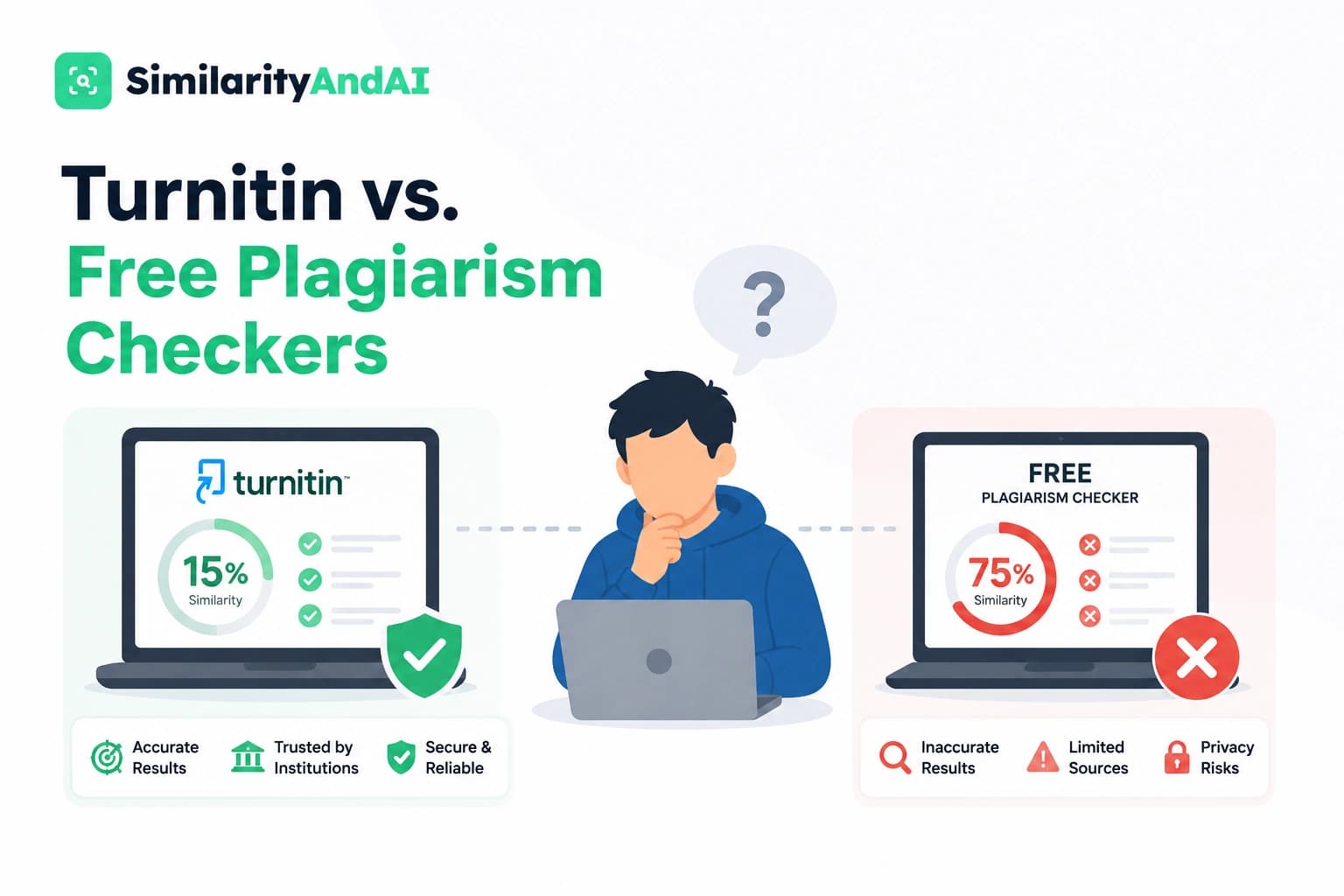
Turnitin compares a submitted document against three broad source pools: an index of web content, a database of academic publications (journals, books, conference papers), and a repository of previously submitted student papers from institutions using Turnitin. According to Turnitin's own product page, that combined index runs into the billions of documents, with licensed access to a large body of academic publishing content that sits behind journal paywalls most free tools can't reach.
That licensed academic layer is the part that matters most for comparison purposes. A free web-crawling tool can only see what's publicly indexed. If the source text you're unintentionally echoing lives inside a paywalled journal article, a textbook chapter, or another student's paper submitted through a university's Turnitin account, a free checker simply doesn't have access to compare against it — regardless of how good its matching algorithm is.
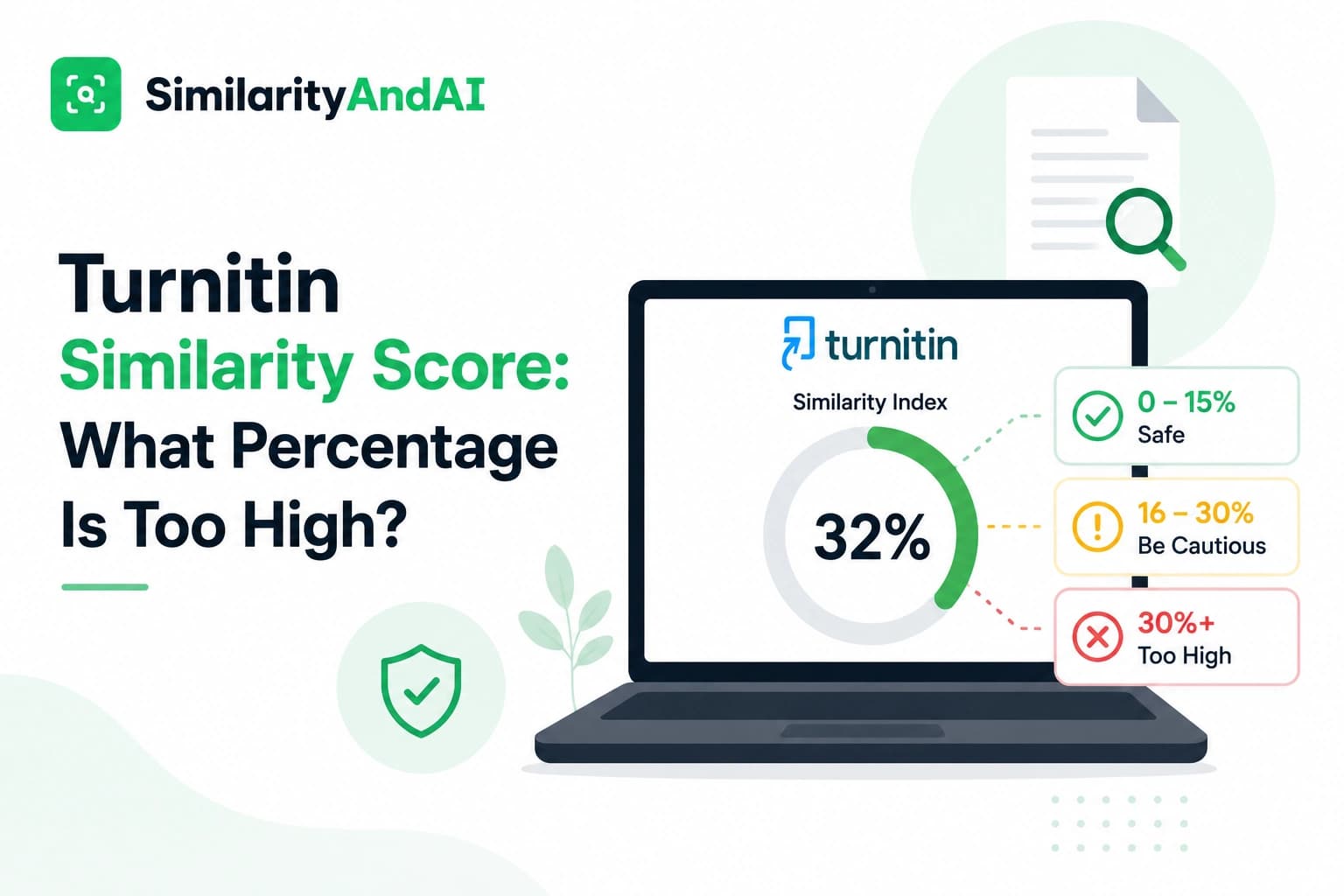
Turnitin also publishes guidance on how its similarity score is calculated: it's the percentage of a submission's text that matches content in its databases, and it explicitly does not equal a plagiarism verdict. Quoted material, properly cited references, and common phrases can all register as matches. The score is a starting point for human review, not an automatic judgment.
What free checkers tend to miss
Three gaps show up consistently when comparing free tools against institutional-grade checkers:
- Paywalled academic sources. If your matching text sits inside a journal article or a book that isn't freely available online, a web-crawl checker won't find it — the content simply isn't in its index.
- Other student papers. Turnitin's repository includes papers submitted by students at other institutions using the same system. Free tools have no access to this at all, so self-plagiarism or overlap with another student's work won't register.
- Heavily paraphrased text. Detecting a close paraphrase — where the structure and sequence of ideas is retained but individual words are swapped — takes more sophisticated matching than a simple text-comparison algorithm. Free tools vary widely here, and lighter-weight checkers tend to miss paraphrased overlap that a more thorough system would catch.
Word or page limits are another practical constraint — many free scanners cap how much text you can check in a single submission, which means checking a full dissertation or thesis chapter by chapter through a free tool is often not realistic.
Why you can't just use Turnitin yourself
This is the part that catches a lot of students off guard: Turnitin doesn't sell its Similarity product directly to individuals. Per Turnitin's own help center, access is licensed exclusively to institutions — schools, universities, and organizations — not to individual students or freelancers looking for a one-off check. There's no consumer signup page on Turnitin's own site.
The one individual-facing product Turnitin does offer is iThenticate, aimed at publishers and independent researchers rather than students, and it's priced per document in a way that makes it impractical for routine coursework — a single check can run well over $100. That pricing gap is exactly why services exist to give students access to genuine Turnitin checks through an institutional account, at a per-report price closer to what a student can actually afford.
When a free checker is genuinely enough
None of this means free checkers are useless. For a quick sanity check on original writing — catching an accidental unattributed quote, spotting a sentence you forgot to paraphrase from your own notes, or scanning a blog post or web article you're not sure you cited correctly — a free tool can be a reasonable first pass. They're fast, require no signup in most cases, and cost nothing.
Where they stop being reliable is as a stand-in for what your instructor will actually see. If your assignment draws heavily on journal articles, textbooks, or other academic sources — which describes most university-level writing — a free tool's 0% or near-0% result doesn't mean Turnitin would return the same number.
A separate issue: AI detection
It's worth separating similarity checking from AI detection, since the two get conflated often. Turnitin's AI writing detector doesn't compare your text against sources at all — it analyzes writing patterns to estimate the likelihood that a passage was generated by an AI tool. Free plagiarism checkers generally don't attempt this at all, and the AI detectors that do exist (free or paid) carry their own accuracy problems.
A Stanford HAI study tested seven popular AI detectors against TOEFL essays written by non-native English speakers with no AI involvement at all, and found the detectors classified 61% of those essays as AI-generated. The researchers linked this to detectors relying on "perplexity" — a measure of how predictable the writing is — which tends to be lower in non-native writing for reasons that have nothing to do with AI use. It's a reminder that an AI score, like a similarity score, is a signal to review rather than a verdict to accept at face value.
The bottom line
A free plagiarism checker and Turnitin aren't competing versions of the same product — they're built against different source pools, and the gap between them is largest exactly where it matters most: academic sources your assignment is most likely to draw from. A free tool can be a fine first pass on your own original writing. For anything citation-heavy or research-based, the only way to know what your institution will actually see is to check against the same database it uses.
If you want to see your real similarity and AI detection scores before you submit, you can check your reports through SimilarityAndAI — the same Turnitin engine your school runs, with your results explained in plain language.
Frequently asked questions
Is a free plagiarism checker ever as accurate as Turnitin?
For catching web-published content — blog posts, articles, other publicly indexed pages — a good free tool can perform reasonably well. Where free tools consistently fall short is against paywalled academic content: journal articles, textbooks, and other student papers submitted through institutional Turnitin accounts. If your source material overlaps with a licensed academic index, a free web-crawl checker often won't see it at all.
Why can't I just sign up for Turnitin directly?
Turnitin sells its Similarity product exclusively to institutions — schools, universities, and organizations — not to individual students. There's no consumer checkout on Turnitin's own site. The only individual-access product Turnitin offers is iThenticate, aimed at publishers and researchers, and it's priced per document in a way that isn't practical for routine student use.
Does a 0% score on a free checker mean my paper is safe?
Not necessarily. It means the checker didn't find a match in the sources it searches — usually the open web. If your matching content sits inside a journal article, a textbook, or another student's paper on file with Turnitin, a free web-only checker has no way to see it, so a low score there doesn't guarantee a low score on the tool your instructor actually uses.
Do free checkers and Turnitin check for the same thing?
Both compare your text against existing sources and return a percentage, but the source pool is the real difference. A checker is only as good as what it's comparing against — a small web-indexed database will always miss more than one built from licensed academic content and a large repository of prior submissions.
Ready to check your paper?
Get your Turnitin reports in minutes.
Same reports your institution generates — delivered privately, fast.
Related articles