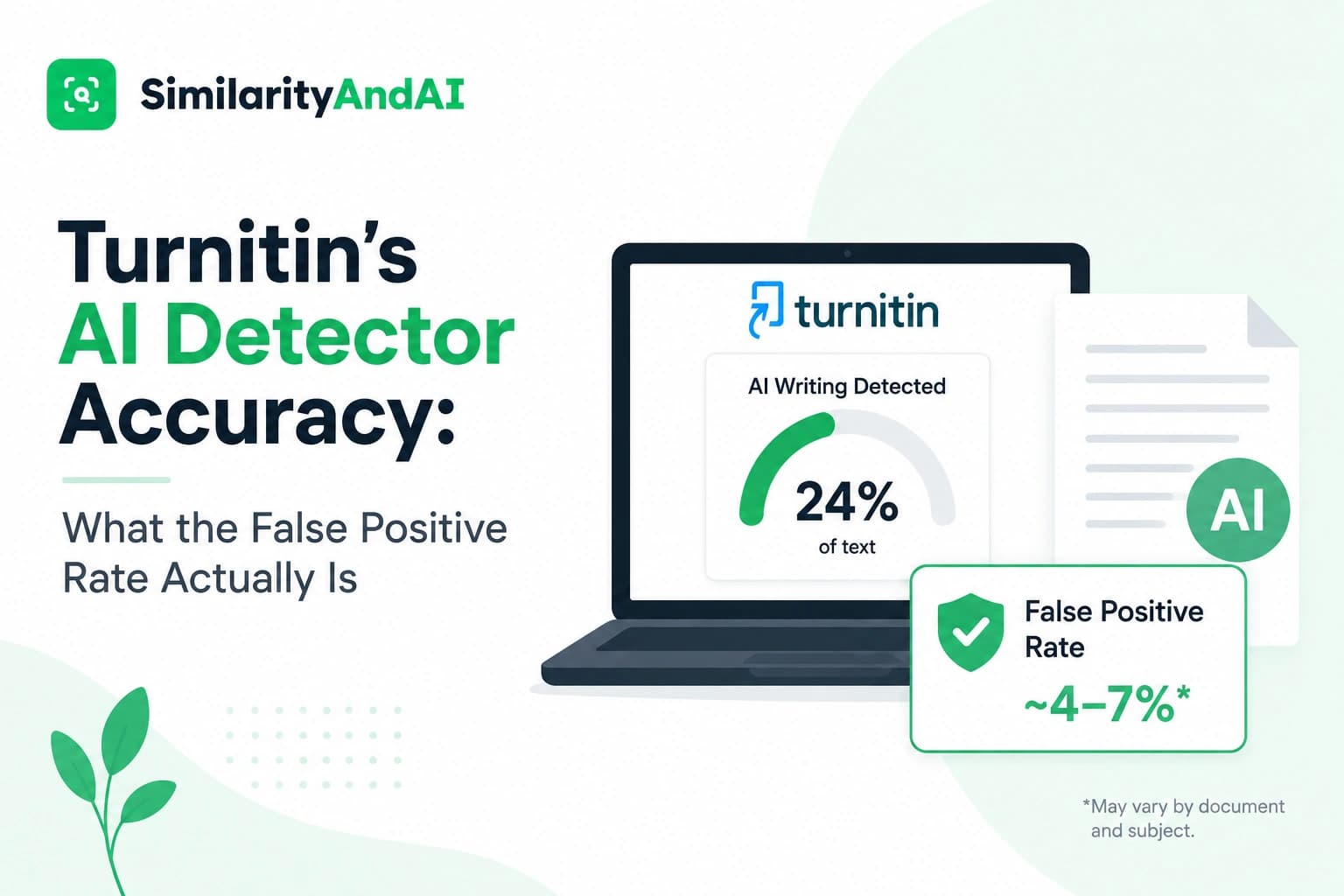
Turnitin's AI Detector Accuracy: What the False Positive Rate Actually Is
Turnitin claims under 1% false positives. Independent studies find higher numbers on specific kinds of writing. Here's what both sides actually measured, and what it means for your score.
The quick answer
Turnitin states its AI writing detector produces fewer than 1% false positives at the document level, on documents where more than 20% of the text is AI-generated. That number is real, but it's narrower than it sounds — it's an aggregate figure from Turnitin's own testing, not a guarantee that applies equally to every kind of writing. Independent studies that specifically test edge cases — non-native English writing, heavily edited drafts, short or formulaic prose — have found meaningfully higher false positive rates. Both sets of numbers are legitimate; they're measuring different things, and the gap between them is the actual story.
How Turnitin's AI detector actually works
Unlike the similarity checker, Turnitin's AI detector doesn't compare your text against a source database at all. It analyzes the writing itself, breaking a document into segments and scoring each one using a model trained to distinguish patterns typical of human writing from patterns typical of AI-generated text. Two properties drive most of that scoring: perplexity, a measure of how predictable each word choice is to a language model, and burstiness, the variation in sentence length and structure across a passage.
AI-generated text tends to run low on both — consistently predictable word choices and fairly uniform sentence rhythm. Human writing is typically burstier: sentence length varies more, word choice is less statistically "safe." The detector aggregates sentence-level scores into a document-level percentage, which is the number students and instructors actually see.
The catch built into this method is the one worth sitting with: those same signals — low perplexity, low burstiness — can show up in human writing too. Formulaic academic prose, writing by non-native English speakers, and heavily edited or templated text can all score lower on burstiness for reasons that have nothing to do with AI use.
Turnitin's own accuracy numbers
Turnitin has been relatively transparent about its testing methodology compared to many AI detection vendors. Its published figures describe better-than-98% overall accuracy and a sub-1% false positive rate — but that false positive figure is explicitly scoped to documents where AI content exceeds roughly 20% of the text, based on internal testing against curated writing samples. Turnitin has also acknowledged that achieving that low a false positive rate involves a tradeoff: the detector can undercount AI-generated content in a document — missing some of it — rather than risk flagging human writing incorrectly.
That's a defensible design choice, and worth stating plainly: Turnitin has been more forthcoming about this tradeoff than most competitors in the space. But it also means the widely repeated "under 1%" figure is a specific, conditional number, not a blanket accuracy rate that applies identically across every document type, language background, and writing style.
What independent studies found
Outside of Turnitin's own testing, results have been less consistent. Academic and journalistic testing of AI detectors — including Turnitin's — against controlled sets of human-written and AI-generated essays has produced false positive rates ranging from roughly the low single digits up into double digits, depending heavily on what kind of writing was being tested. The pattern that shows up repeatedly: detectors perform closest to their advertised accuracy on straightforward native-English prose, and drift furthest from it on writing that's short, heavily templated, non-native, or has been edited or paraphrased after the fact.
None of this means Turnitin's detector is unreliable across the board — most testing still finds it among the stronger performers relative to competing AI detection tools. It means the single headline accuracy number obscures real variance underneath it.
The bias question: non-native English writers
This is the specific edge case that gets cited most often, and for good reason. A Stanford HAI study tested seven popular AI detectors against TOEFL essays written by non-native English speakers — genuine human writing, no AI involvement — and found the detectors classified 61% of those essays as AI-generated. The researchers tied this to perplexity specifically: non-native writing tends to use more predictable vocabulary and simpler sentence structures, which overlaps with the statistical signature detectors associate with AI text, for reasons that have nothing to do with whether an AI actually wrote it.
It's worth being precise about scope here: that study tested seven detectors on essays under 150 words, and Turnitin's detector wasn't among those tested, in part because Turnitin's system doesn't generate a score for documents that short at all. So the 61% figure is a real and important finding about AI detectors as a category — it is not, strictly, a finding about Turnitin specifically.
Turnitin's rebuttal research
Turnitin responded directly to the broader bias concern with its own study, testing close to 2,000 writing samples from English Language Learners against a comparable set from native English writers, restricted to documents meeting its 300-word minimum. According to Turnitin's published results, the false positive rate came out to 1.4% for ELL writers versus 1.3% for native English writers — a difference Turnitin characterizes as not statistically significant.
So there are genuinely two credible, methodologically different studies pointing in different directions, and the honest reading is that they don't directly contradict each other so much as measure different things: short essays across seven detectors that excluded Turnitin, versus longer documents tested specifically on Turnitin's own model. Anyone telling you this question is fully settled — in either direction — is oversimplifying a genuinely open research area.
Why the numbers don't agree
Three structural reasons explain most of the gap between Turnitin's figures and independent findings:
- Different test sets. A false positive rate measured against typical university coursework will differ from one measured against a curated set of edge cases specifically chosen to stress-test the detector.
- Document length thresholds. Turnitin doesn't score very short documents at all. Studies that include short essays are, by definition, testing scenarios Turnitin's own detector wouldn't weigh in on in practice.
- What counts as a "false positive." Document-level scores and sentence-level flags behave differently. A document can carry a low overall AI percentage while still having individual sentences flagged, and how a study defines and counts a false positive materially changes the resulting rate.
What kind of writing tends to get flagged
Across both Turnitin's own disclosures and independent testing, a few consistent patterns show up in human writing that scores unexpectedly high:
- Formulaic, templated writing. Lab reports, standardized business writing, and other formats with rigid expected structure naturally have lower burstiness.
- Heavily edited or over-polished prose. Writing run through grammar tools, translated, or extensively revised for concision can flatten the natural variation that signals human authorship to the model.
- Non-native English writing. As above — simpler, more statistically predictable sentence construction can read as low-perplexity even when entirely human-written.
- Very short passages. Less text gives the model less signal to work with, which is part of why Turnitin doesn't score documents below its minimum length at all.
How Turnitin tells schools to use the score
This is the part that gets lost in most discussions of accuracy, and it's arguably the most important context: Turnitin's own guidance is explicit that the AI score should not be used as the sole basis for an academic integrity decision. The recommended process treats a flagged score as a prompt for further review — a conversation with the student, a look at drafts or document history, and human judgment applied against the institution's actual policy — rather than an automatic verdict. Turnitin frames the number as a probabilistic estimate, not a determination of misconduct.
In practice, how closely individual instructors and institutions follow that guidance varies. But it means a flagged score, on its own, is not equivalent to a finding of AI use — even by Turnitin's own stated standard.
What this means if you're worried about your own paper
If your writing tends toward any of the patterns above — English isn't your first language, your discipline expects formulaic structure, you write cleanly and edit heavily — it's reasonable to want to see your actual AI score before you submit, rather than finding out for the first time when your instructor does. That's a different motivation than trying to game a detector; it's simply knowing what a human reviewer is going to see and being ready to explain your process — drafts, notes, revision history — if the number comes back higher than expected.
This is also where similarity and AI detection are easy to conflate but worth keeping separate, a distinction covered in more depth in our comparison of Turnitin and free plagiarism checkers: a similarity score measures textual overlap with existing sources, while the AI score is an entirely separate statistical estimate about how the text was likely produced. A clean similarity report says nothing about your AI score, and vice versa.
The bottom line
Turnitin's AI detector is more transparent about its methodology and tradeoffs than most competitors, and its aggregate accuracy numbers are genuinely strong. But "under 1% false positives" is a specific, conditional claim, not a universal guarantee — and independent research keeps finding that certain kinds of legitimate human writing, non-native English prose especially, are more likely to be misread. The honest position is that both Turnitin's numbers and the studies that complicate them are credible; the score is a signal worth taking seriously, not a verdict to accept — or fear — at face value.
If you want to see your actual AI detection and similarity results before you submit, you can check your reports through SimilarityAndAI — the same Turnitin engine your institution uses, run in No Repository Mode so checking ahead of time never affects the submission that counts.
Frequently asked questions
What false positive rate does Turnitin claim for its AI detector?
Turnitin states under 1% false positives at the document level, specifically on documents where more than 20% of the text is AI-generated, based on its internal testing. That figure comes with a tradeoff Turnitin itself acknowledges: to keep false positives that low, the detector can miss a meaningful share of AI-generated text rather than risk flagging human writing incorrectly.
Do independent studies agree with Turnitin's accuracy claims?
Not consistently. Published studies testing Turnitin against human-written essays — particularly non-native English writing, heavily edited drafts, and technical or formulaic prose — have found false positive rates well above Turnitin's stated figure, in some cases into double digits. The gap largely comes down to what's being tested: Turnitin's number describes typical student writing in aggregate, while independent studies often specifically target the edge cases most likely to produce a false flag.
Is Turnitin's AI detector biased against non-native English speakers?
The evidence is mixed and contested. A widely cited Stanford study found detectors misclassified the majority of TOEFL essays by non-native speakers as AI-generated — though Turnitin's own detector wasn't part of that specific test, since the essays were too short for it to score. Turnitin later published its own research on nearly 2,000 English Language Learner writing samples and reported no statistically significant difference in false positive rates compared to native English writers. Both are real studies; they simply tested different things.
Can a school discipline a student based on a Turnitin AI score alone?
Turnitin's own guidance explicitly says no — the AI score should not be used as the sole basis for an academic integrity decision. It's designed to prompt further review: a conversation with the student, a look at drafts or version history, and human judgment applied against the institution's actual policy, not an automatic verdict.
Ready to check your paper?
Get your Turnitin reports in minutes.
Same reports your institution generates — delivered privately, fast.