What Does the Asterisk (*) Mean on a Turnitin AI Report?
An asterisk instead of a number isn't a glitch — it's Turnitin deliberately withholding a precise score. Here's exactly what range it covers, why Turnitin built it this way, and how it's different from both 0% and "unavailable."
The quick answer
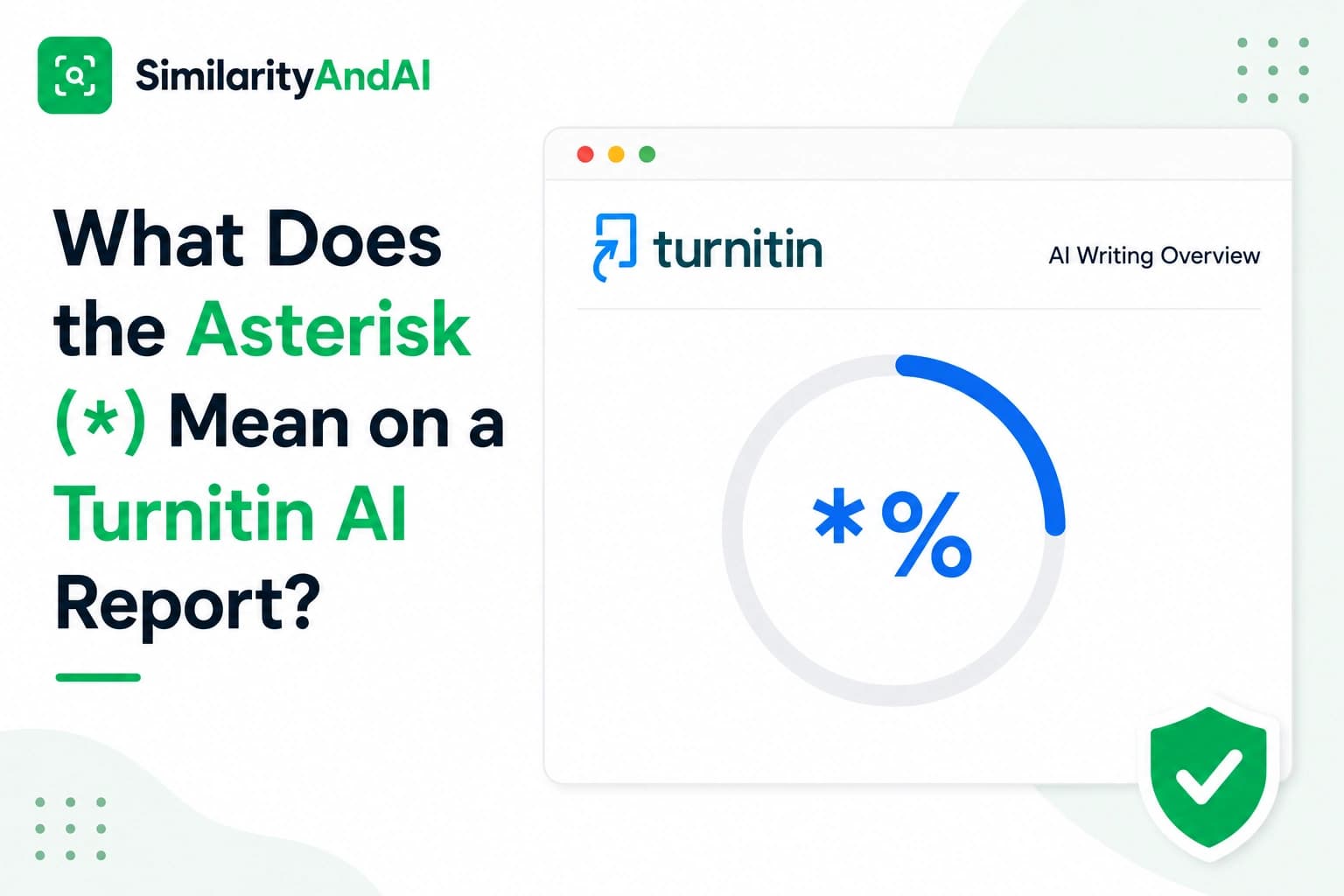
An asterisk (*%) in place of a number on a Turnitin AI Writing Report means the detector found some text resembling AI-generated patterns, but at a level below 20% — and Turnitin has deliberately chosen not to display a specific percentage in that range at all. It isn't a bug, a placeholder, or a rounding artifact. It's an intentional design decision Turnitin built directly into the reporting interface, specifically because its own testing found that low-percentage results carry a meaningfully higher risk of being false positives.
Why Turnitin built it this way
Turnitin publishes accuracy figures for its AI detector — better than 98% overall accuracy, with a stated false positive rate under 1%, but explicitly scoped to documents where AI-generated content exceeds roughly 20% of the total text. Below that threshold, the signal the detector is working with gets thinner, and the risk of misreading ordinary human writing as AI-generated increases. Rather than display a specific number that might overstate the detector's actual confidence in that range, Turnitin's design replaces the number with an asterisk — a visible acknowledgment that the result exists, but shouldn't be read with the same precision as a number above 20%.
This is a genuinely unusual choice in the AI detection space, where most competing tools simply display whatever number their model produces regardless of confidence level. Deliberately withholding precision in a range it doesn't trust is, if anything, a point in favor of Turnitin's stated approach to the accuracy tradeoffs covered in more depth in our piece on Turnitin's AI detector accuracy and false positive rate.
Three different results, easily confused
A Turnitin AI report can show one of three meaningfully different things, and mixing them up is a common source of confusion:
- 0% (a number, with a blue indicator). The detector processed the document successfully and found no text resembling AI-generated patterns. This is a completed, confident result.
- An asterisk (*%). The detector processed the document successfully and found some AI-pattern text, but at a level — roughly 1% to 19% — below its threshold for displaying a specific figure.
- "AI Writing Detection Unavailable." The report couldn't be generated at all. This is a technical failure, not a content finding — the document was too short, in an unsupported format, or exceeded a size limit, and has nothing to do with whether AI content is present.
The distinction between the asterisk and "unavailable" specifically trips people up, since both can read as "no clear answer" at a glance. They mean genuinely different things: one is a completed low-confidence result, the other is a failed report generation.
What the asterisk does not mean
It doesn't mean your paper was flagged for misconduct, and it doesn't mean the detector is certain something is wrong with your writing. It also isn't a rounded or softened version of a specific number that exists somewhere else in the system — there's no hidden precise percentage an instructor can unlock. The asterisk replaces the number entirely; it's the actual, final state of that result, not an intermediate step toward a more specific one.
Does an asterisked report still get reviewed?
Whether it prompts any action at all depends entirely on your institution and instructor, not on Turnitin. Since Turnitin's own stated position is that low-percentage results in this range carry meaningfully higher uncertainty, an asterisk on its own is a weak basis for any conclusion — a point that applies with even more force here than it does to a displayed percentage. The general review process covered in our piece on what happens if Turnitin flags you still applies: a human decides what, if anything, an unusual result is worth looking into.
Why this small detail actually matters
It's a small piece of interface behavior, but it says something real about how Turnitin approaches its own detector's limitations: rather than presenting every result with the same apparent precision, it explicitly separates the range where it trusts its own output from the range where it doesn't. For a student trying to understand a result, that distinction is genuinely useful information — an asterisk is Turnitin itself telling you the number underneath it isn't reliable enough to show, which is a meaningfully different situation from a confident, displayed percentage.
The bottom line
The asterisk on a Turnitin AI report is a deliberate design choice, not a glitch or a hidden number — it marks results in the roughly 1–19% range where Turnitin's own testing found lower confidence and a higher chance of a false positive. It's distinct from both a clean 0% result and a failed "unavailable" report, and on its own, it isn't evidence of anything — just an honest acknowledgment of where a statistical detector's confidence runs out.
If you want to see your actual similarity and AI detection results before you submit, you can check your reports through SimilarityAndAI — the same Turnitin engine your institution uses.
Frequently asked questions
What percentage range does the asterisk cover?
Roughly 1% to 19%. Turnitin's AI writing detector found some text resembling AI-generated patterns, but below the confidence threshold it uses to display a specific number. Above that range — 20% and up — Turnitin shows the actual percentage.
Is an asterisk worse than a 0% score?
Not necessarily worse — it's a different category, not a higher risk level on the same scale. A 0% score means Turnitin detected no AI-pattern text at all. An asterisk means it detected a small amount, but not enough to meet its confidence bar for reporting an exact figure. Neither is a finding of misconduct on its own; both are simply what the detector found within its own stated limitations.
Is an asterisk the same as 'AI Detection Unavailable'?
No, and mixing these up leads to real confusion. An asterisk means the report was generated successfully and the score simply falls in the low-confidence range. "Unavailable" means the report couldn't be generated at all, typically because the document failed a technical requirement — too short, wrong file format, or over the size limit — and has nothing to do with AI content one way or the other.
Can my instructor see the exact percentage behind the asterisk?
No — Turnitin does not display a hidden precise number to instructors either. The asterisk replaces the percentage entirely in the report interface; it isn't a rounded or hidden version of a number that becomes visible with different permissions.
Ready to check your paper?
Get your Turnitin reports in minutes.
Same reports your institution generates — delivered privately, fast.